
 Instant Access After Purchase



Refine Your Lower Lid Surgical Technique and Maximize Results
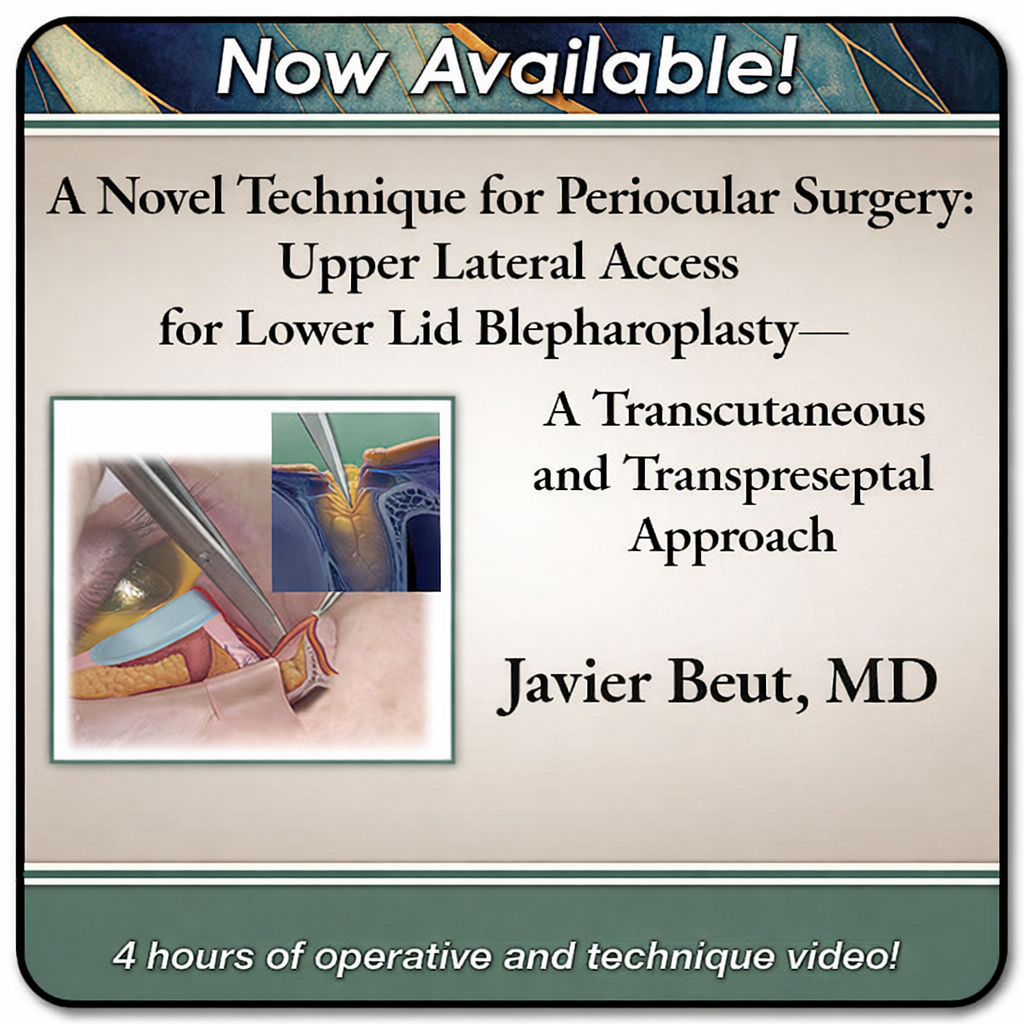
In this comprehensive video series, Javier Beut presents an innovative approach to lower eyelid rejuvenation using upper eyelid access for lower lid blepharoplasty, guided by the principles and surgical philosophy of Richard L. Jelks.
Through detailed analysis and operative demonstrations, Dr. Beut evaluates the effectiveness of this technique as a less invasive and anatomically sound method for managing lower eyelid fat pads. Two patients illustrate two distinct surgical pathways—transcutaneous and transpalpebral—highlighting how access selection can be tailored to individual anatomy and aesthetic goals. The emphasis throughout is on achieving optimal aesthetic outcomes while minimizing complications, in alignment with Jelks’ core principles of facial anatomy, tissue respect, and surgical precision.
This introduction establishes the framework for a focused discussion of technique selection, outcomes, and the broader implications for both cosmetic and reconstructive eyelid surgery.
Nonsurgical Tear Trough Management: The Blending Technique
The series also explores the “blending technique” for nonsurgical treatment of the tear trough deformity. This method effectively improves the lid–cheek junction by addressing both the tear trough deformity and the palpebromalar groove.
Rather than filling, the technique focuses on blending, achieved through targeted hyaluronic acid injections delivered along vertical vectors to smooth the transition between anatomical zones and restore a natural contour.
Patient evaluation is critical. Individuals are classified as “innies” or “outies” based on the position of the arcus marginalis relative to the orbital bone:
-
Innie patients are ideal candidates for hyaluronic acid placement in the gap between the arcus marginalis and the orbital retaining ligament to correct the tear trough groove.
-
Outie patients benefit more from volumization and structural support of the deep medial cheek—specifically the deep middle fat pad at the pyriform fossa and premaxillary space—rather than direct tear trough injection.
This classification system helps optimize outcomes while reducing the risk of contour irregularities.
4 Cases | 4 Hours of Operative & Technique Video
Case 1 – Secondary Blepharoplasty
Standard upper eyelid blepharoplasty without fat removal, upper lateral access for lower lid blepharoplasty (transpreseptal approach), canthal support, inferior lateral retinacular canthoplasty, periorbital fat grafting, and preseptal orbicularis muscle graft.
Case 2 – Primary Transcutaneous Blepharoplasty
Primary transcutaneous lower lid blepharoplasty with canthoplasty, periorbital fat grafting, standard upper eyelid blepharoplasty with fat and muscle removal, upper lateral access for lower lid blepharoplasty (transcutaneous approach), canthal support, inferior lateral retinacular canthoplasty, and preseptal orbicularis muscle graft.
Case 3 – Nonsurgical Tear Trough Correction
Blending technique using hyaluronic acid.
Case 4 – Nonsurgical Tear Trough Correction
Blending technique using hyaluronic acid.
Summary
This video series offers a structured, anatomy-driven approach to both surgical and nonsurgical lower eyelid rejuvenation. By integrating upper lateral access techniques, patient-specific strategy selection, and refined volumization concepts, Dr. Beut provides practical insights aimed at improving outcomes while minimizing risk—making this an essential resource for surgeons seeking precision and reliability in periocular surgery.
Reviews
There are no reviews yet.